This is a frontpage for other items to refer to.
Given that over 700 longstanding hard conjectures have been announced as resolved on a single day – October 7th 2026 – our first response is this.
To declare various speculations and for now loose conjectures on AI in Mathematics that we have made between October 2017 and the end of September 2026. Staking a claim on whichever of them are conceptually distinct and have not yet appeared elsewhere. In case in which we find that identical, or in our opinion, very similar claims have been made before, we shall attach references and footnotes. Be it for concepts, or results, or names, or notations, or technical-mathematical drawing and visualization styles. Kindly return the courtesy by yourselves ceasing ascribe to concepts, names, notations and technical-mathematical drawing and visualization styles somehow not being worth citation. After all, it is presently unclear whether people will still be paid to prove mathematical results even in 5 years time, let alone in 50 years time, i.e. within the working lifetime of new students.
- Protein folding improvements were met here in 2017 by S. Sanchez’ suggestion that AI is disproportionally good at solving problems that look like its own internal constitution. Use a huge variational calculus engine to solve a huge variational calculus problem…
1.1 We therefore took an interest in another major component of the internal working of AI: linear algebra and multilinear generalizations. This led to a partial book manuscript in 2023, and the start of the online encyclopaedia of tensors and other multilinear arrays in 2026. Where also over 10 sample chapters from the 2023 book are to be found. Further parts of this are graduate-level, including in many ways that do not feature in the current top books, such as Dym or Roman through to the handbook of linear algebra. Due to item 1, we used graduate level publicly unknown linear algebra exercises to test publicly available AI capacity. In fact, we started writing this text on October 4th after Gemini became the first publicly available AI to pass our very high-standard test in this subject. So this took Gemini slightly 1 year longer than being able to ‘get an IMO gold medal’.
1.2 So this time we also beta-tested whether this publicly available Gemini could do a type of mathematics not like the known internal procedures of an LLM. As per item 2 below, we chose the following sequence. Can Gemini do Order Theory? Including with poset Hasse diagram outputs? That can be prompted into comparable shape to the restriction of ed. Roberto Tamassia’s Handbook of Graph Drawing and Visualization from graph drawing to poset drawing? And can consequently be used to harness Wille’s concept lattices? To the extent that this procedure can detect, display as dectatable by eye, and optimize the drawing and visualization of the following. Detecting a citizen of Kallista by its domination of Wille lattices that it naturally pertains to.
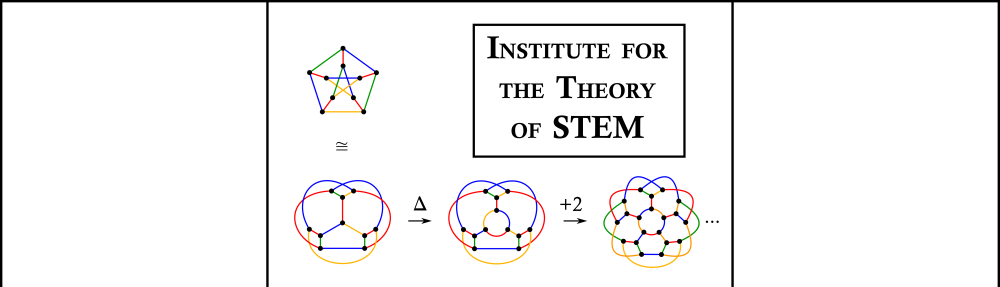
Where a citizen of Kallista is a beautiful mathematical structure, highly multi-faceted. Such as the Fano plane, Hopf’s little map or the Petersen graph. For all that some comparable ones are more widely known, say the real line and the complex plane. As are various somewhat weaker ones such as the tetrahedron or the two Kuratowski graphs. Bigger examples include the Tutte-8 and -12 cages. Our Institute’s Summer Schools and Reviews have largely concentrated on some of these, and nothing that has happened has changed our plans to eventually cover the larger Hopf maps, the Petersen graph and its heirs, and the far larger collection of heirs of Fano.
2. S. Sanchez speculated in 2017 that Wille’s concept lattice would be the first mathematical tool that can be productively used in any intellectual discipline’s Modern Applied Topology program to which the following would apply. It would be the first automated tool to be able to detect citizens of Kallista in whichever subject has sufficiently sharply defined concepts to use Mathematics. To make some estimates of their relative strengths. To form one type of arena for them: mathematical space of the totality of some particular type of mathematical object. And to be very finitely promptable into displaying these within the abovementioned 2014 technical-mathematical drawing and visualization standards.
3. S. Sanchez and E. Anderson speculated in 2018 that many combinations of 2, 3, 4… basic mathematical subjects had not actually been thoroughly searched by mathematicians.
One reason for this is modern applied topology’s large likelihood of having relevant arenas of objects from subject A not themselves belonging to subject A. For instance, the arena of vertex-labelled mirror-image distinct triangles modulo similarities is not a triangle but a sphere (Smale 70, Kendall 84) And the arena of all integer partitions is the Young lattice: part of Order Theory.
Another is that the number of subjects exploded in the 30s and again in the 60s. So nobody for instance systematically back-tracked school-level Euclidean Geometry using linear algebra in detail. And so we got around 80 research projects’ worth out of using second-year linear algebra in detail on school-level Euclidean Geometry. The main tricks were to use quadratic forms not determinants, since determinants had been used in detail from Sylvester and Dodgson (alias Lewis Carroll) through to the review books by Muir.
So say with the quadratic forms, Buchholz’s Heron matrix is 3 x 3 to the Heron deteminant being 4 x 4. And nobody had remarked (that we could find) that this was the same matrix as the cycle of cosine rules or of triangle inequalities. Or that its joint eigentheory wih the Lagrange matrix gives Hopf’s little map. And thus new proofs of Smale’s and Kendall’s little theorems that the arena of triangles as above is respectiviely topologically and then metrically a sphere. Nor had anybody followed this lead: Apollonius matrix commutes with both of previous, and is unrealized linear algebra counterpart of a result from 1920s textbook by Johnson. All 3 are combinatorial matrices, as exploited by A. Ford. This generalizes to 1 Apollonius theorem per N-body Jacobi network (indexed by A.F. and E.A.), infinite family supplied by E.A. Among which only 1 was previously known: the Jacobi H returns Euler’s quadrilateral theorem. Proven by moments methods, we then extended it to a moments proof of Stewart’s theorem, and the same enumeration of infinte family of generalizations of that (S.S, A.F, E.A. and K. Everard) We furthermore chased down the Brahmagupta and Bretschneider counterparts, finding Ptolemy’s mathematics taking over here from multiplication-incompatible Apollonius generalizations. And so on.
The next trick was to use adapted variables. Eg weak Conway squares turns the triangle inequality into an analogue of the Special Relativity cone condition, signifying limiting case of area zero! With the same run at Ptolemy revealing an ultrahyperbolic counterpart. Brahmagupta however gives back null directions, so that its 4-cycle neatness in excess of Heron’s formula is not backed up by Brahmagupta linear algebra being nicer than Heron’s.
There were further tricks and further situations; we still have around 20 articles’ worth lying around not typed up, just because ‘they exceed what fits in E.A.’s book and what we can type up in reviews for the next several years’.
We have similarly found new research using first-year combinatorics on linear algebra and tensors. We are currently starting to exhibit this for the eigentheory of the real-symmetric matrix (E.A. and K.E.). While having put out 8 of our 9 research articles’ worth on Cartesian tensors into a review, which shall eventually pick up ithe last one as an extra chapter: isotropy.
So at least some combinations of basic subjects have large amounts of unexplored territory lying in between them, using just parts of the originals to make many new inferences about the two subjects together.
We came across some professor calling this ‘filling out the convex hull’ on youtube. We will track this down and cite it here shortly. We have learned to prefer to say that “hull” is a less commonly encountered alias of “span”. And that “convex” is a harder version of “linear”. To the extent that there is also a convex combination, convex (in)dependence, convex basis… With 100 times more students or ex-students, at least, having come across the linear versions of all these things. So let’s rename it ‘filling out the linear span’ for purposes of pedagogy. We shall invesitgate shortly whether the ‘convex’ analogy is deeper than this pedagogical linear one.
This is associated with the following trichotomy. ‘Linear spans’ of mathematically sharp subjects are much smaller than the subjects. Around the same size as the subjects. Or are much larger than the subjects. Many mathematicians assumed nothing would be found combining the likes of school Euclidean geometry, second year linear algebra and first year combinatorics. This places them to some extent in the first camp. E.A. in 2026 conjectures however the opposite extreme. Pointing to the above as a first inkling of specific evidence in the toy model case of ‘the easiest three university level subjects’ (Quite a few universities offer, or have offered, Euclidean geomety to the above kind of standard. Even if some schools do so also, as do some mathematics competitions for school students).
It is an interesting question whether some other pairs or triples of subjects have been well filled in. After all, graduate courses often build towers of simpler graduate courses’ ideas. What the above points to is tthat the very simplest starting points of university mathematics have not had their span filled in. Which is rather suggestive of applying both Modern Applied Topology moves and the S.S. and E.A. style moves to an expanding combination of further subjects. To see if these ever stop producing new results.
3 Conjecture (S.S. and E.A. 2018) AI will be good at the linear span sweeping problem (our name for convex hull filling problem).
By this 2 paragraphs back could well be automatable or at least be done in partnership with AI. Trials on whether Gemini can help shall be conducted for a few weeks. If this works out, we might then investigate whether other free AI is better or worse for finding such results.
I.e. one suggestion is to partner with AI to find new basic things that were missed. We found close to 400 articles’ worth of this prior to the age of advanced AI. Nor was ours a systematic search. We just took what conceptually pleased us. The point being, sure, one can see if AI can solve harder problems. Including whether free AI can. But our suggestions is that people should not put in all of the AI compute time into this venture. Because it is also interesting to see how many basic combinations mathematicians missed. And some people would prefer to find something that undergraduates or even schools might come to standardly mention. As opposed to something which remained unsolved on the cutting edge of some research field that only “5 to 100 people alive at any point understood the significance of”. This has the further benefit that less specialized people can more reasonably assess whether hitherto missed simple combinations of basics are correct, new and significant. Even to the extent that currently existing free proof checkers can handle this. While some of what was released yesterday does not yet carry proof checker approval.
We shall return to this topic each day for a while, for the above list extends past the current 3 items. And subsequently convert this text to sharper and more easily maintainable pdf output from a tex file, as per one of the norms that might survive the next 5 years…

